The Question Every Region Must Answer
Every region must eventually answer one hard economic question:
What does it create that the outside world needs?
This question is more important than it first appears. A region can have aspiration, talent, culture, natural beauty, public work, education, internet access and a large youth population. It becomes stronger when more of that potential is connected to value that others are willing to pay for.
If a place mostly consumes what is produced elsewhere, money flows out. If it produces valuable goods, services, knowledge, skills or technology that the outside world needs, money flows in. Over time, that difference shapes the quality of jobs, the confidence of families, the strength of local businesses and the ability of young people to build a future without feeling that leaving is the only serious option.
This is the economic question behind #InnovateInUttarakhand.
The movement is not only about innovation as a cultural word. Events, posters, inspiration and student enthusiasm can all help. The deeper question is whether Uttarakhand can add economic engines around high-value capability.
An economic engine is an activity through which a region creates value for the outside world. Tourism is one such engine. Agriculture, horticulture, herbs, food processing, education, healthcare, public service, manufacturing, local enterprise and community work all matter. They are already contributing to the state and will remain important.
The argument is additive: the next pillar of opportunity should include high-value knowledge production.
Cybersecurity. Cloud computing. Robotics. Drones. Artificial intelligence. Engineering services. Scientific research. Product building. Digital infrastructure. These are not fashionable words to decorate a website. They are parts of the modern production chain. They are where a growing share of global value is being created.
Uttarakhand should also become a producer of these capabilities.
Technology Use Can Become Production
Modern technology gives students unprecedented access.
A student can watch world-class lectures, use advanced apps, generate content, play global games, attend online classes, buy from large marketplaces and depend on cloud systems without understanding how any of it works. This access is useful. It opens doors that earlier generations did not have.
But access is not the same as participation in production.
If our schools use software built elsewhere, our hospitals depend on digital systems built elsewhere, our businesses run on cloud infrastructure designed elsewhere, our young people consume platforms built elsewhere, and our public life increasingly depends on cyber systems secured elsewhere, then we are participating in modern technology mostly as users.
Use matters, and the next opportunity is to help more students enter the value-creation side.
The highest value is usually captured by those who build the systems, secure them, operate them, improve them, design the hardware, create the platforms, train the models, write the tools and own the products. A region can use modern technology and still leave a larger opportunity untapped if too few young people enter the production side.
That is why the distinction between technology use and technology production matters.
Use asks, “Which tool can I use?”
Production asks, “How does this system work, where can it fail, how can I improve it, and what can I create with it?”
That shift changes the purpose of technical education.
At the basic-use layer, a computer lab is a place where students learn operations. At the production layer, it becomes a place where students write code, break and fix local networks, understand Linux, deploy small cloud systems, learn electronics, test sensors, document failures and collaborate on projects.
At the basic-use layer, cybersecurity is a career option someone may choose later. At the production layer, cybersecurity becomes strategic literacy. Students learn that as money, identity, education, healthcare, communication, industry and public services move into digital systems, protecting those systems becomes a form of value creation and national service.
At the basic-use layer, a seminar is a one-day event. At the production layer, a seminar is the first step toward clubs, labs, CTF practice, mentoring and repeated exposure to difficult problems.
The difference is continuity.
Why This Matters More For A Hill State
For Uttarakhand, the economic question deserves special attention because geography shapes opportunity.
Many hill districts face distance, terrain, smaller markets and different industrial conditions from the plains. Large factories cannot be placed everywhere. Every town cannot become a manufacturing cluster. Physical logistics are real considerations. Roads, connectivity and infrastructure matter deeply, and knowledge work can add another route because it depends more directly on human capability.
This respects those sectors and public effort. It is also a reason to add a new dimension.
Knowledge work changes part of the equation because it depends heavily on human capability. A cybersecurity researcher from Almora can find a vulnerability in software used globally. A cloud engineer in Pithoragarh can help a company scale systems across continents. A drone team in Chamoli can work on terrain mapping, agriculture, disaster response or infrastructure inspection. A student from a small town who becomes strong in CTFs, Linux, networks and programming can enter a global technical conversation.
This does not make the path easy.
It makes the path worth building.
The goal is not to pretend that geography no longer matters. Internet access, power, schools, colleges, transport, equipment and mentors all matter. But once a student enters a deep technical path, the limiting factor begins to shift from physical location toward capability, discipline, standards and mentorship.
That is encouraging for Uttarakhand.
The hill temperament is suited to long work. Terraced fields were not made through short enthusiasm. Service traditions were not built through convenience. Communities in difficult terrain already understand patience, duty and persistence. Deep technical work needs the same qualities.
The challenge is to convert that temperament into modern production capability.
The Additional Growth Layer
Regions become stronger when production capability grows alongside consumption.
This is not only a financial matter. It is a capability matter. It appears in a practical way: young people use sophisticated technology, schools use digital tools, local businesses use cloud systems, and public life depends on digital infrastructure. The opportunity is to help more students understand, build, secure and improve these systems.
Existing sectors and public work already support the state in important ways. High-value technical capability can sit beside them and bring another stream of opportunity into the region.
This is why innovation matters as a new dimension. People need purchasing power, but a region also benefits from earning power rooted in skilled production. It needs the dignity of earned capability.
High-value technical capability can strengthen this additional growth layer.
It does so not by replacing every sector, but by adding another layer of production. A student who learns to debug systems becomes more employable. A student who learns to secure systems becomes valuable in a world where digital risk is increasing. A student who learns to build projects becomes more capable of product work. A student who learns to document, communicate and collaborate becomes more useful to teams. A student who learns to handle failure becomes more ready for research and entrepreneurship.
Multiply that by hundreds and then thousands of students, and a region begins to change.
The First Requirement Is Talent. The Second Is Proof. The Third Is Continuity.
Talent is not absent in Uttarakhand.
It is often undiscovered or learning without a clear pathway. Many students are curious. Some are highly capable. Some are already learning online in isolation. Some have the temperament for difficult work but need local examples that make the path feel real.
Proof matters because students and parents take a path seriously when they can see someone nearby attempt it. A public achievement is useful because it changes imagination. It tells a student, “Someone from here has begun.” It tells a parent, “This is not a distraction.” It tells a school, “This pathway deserves support.” It tells a mentor, “Your time can compound.”
Continuity matters because one seminar cannot create an economic engine.
A region needs repeated practice, mentors, clubs, labs, competitions, public records, school collaborations, technical events and examples that remain visible long enough to shape behaviour. It needs enough continuity that the next student starts ahead of the previous one.
This is how a talent pool forms.
Talent pool formation is the economic core of the movement. One exceptional student matters. Ten serious students matter more. A hundred students with solid foundations begin to change the local environment. A thousand students who have touched Linux, networks, cloud systems, robotics, drones, security practice, project work and public problem solving become a regional asset.
The region becomes more attractive to mentors. Schools become more willing to host programs. Alumni find clearer ways to contribute. Local companies find better interns and junior talent. Founders begin with more confidence. Public-service needs can be supported by capability that grows nearby. Students become less dependent on distant validation.
That is how an economic engine gains momentum.
Why Cybersecurity Is A Strong First Path
Cyber Gold Quest is one instrument in this economic argument.
At first glance, it looks like a medal mission. The name points toward a cyber champion, and the medal gives the journey a visible summit. But the deeper outcome is a larger pool of students who can think, build, secure, debug and compete.
Cybersecurity is a strong first path because it sits directly inside the modern value chain. As physical value moves into digital systems, digital security becomes essential. Money, identity, education, healthcare, public services, industry, communication and national infrastructure all depend on systems that must be protected.
Security is therefore not only a career option. It is a strategic capability.
Cybersecurity also has a practical advantage for a hill state: it depends heavily on human skill. A serious student with a computer, internet access, mentorship and disciplined practice can build globally relevant capability from almost anywhere. The student must still work hard. The standards are demanding. But the path does not require a large factory or an industrial cluster before the first serious learner can begin.
Students preparing for CTFs, hackathons and cyber competitions learn foundations that remain valuable beyond the podium: Linux, networks, programming, cryptography, web security, forensics, reverse engineering, cloud security, documentation, debugging and adversarial thinking. Only a few may stand on podiums. Many can become much stronger while walking the path.
That is why a champion matters.
A champion is proof. The talent pool is the economic result.
Schools Are Economic Infrastructure
If students encounter serious technical work only after college, many will already have narrowed their imagination. They may have chosen degrees without understanding fields. They may have developed habits of passive learning. They may have missed the years when curiosity is easiest to shape.
Schools therefore matter economically.
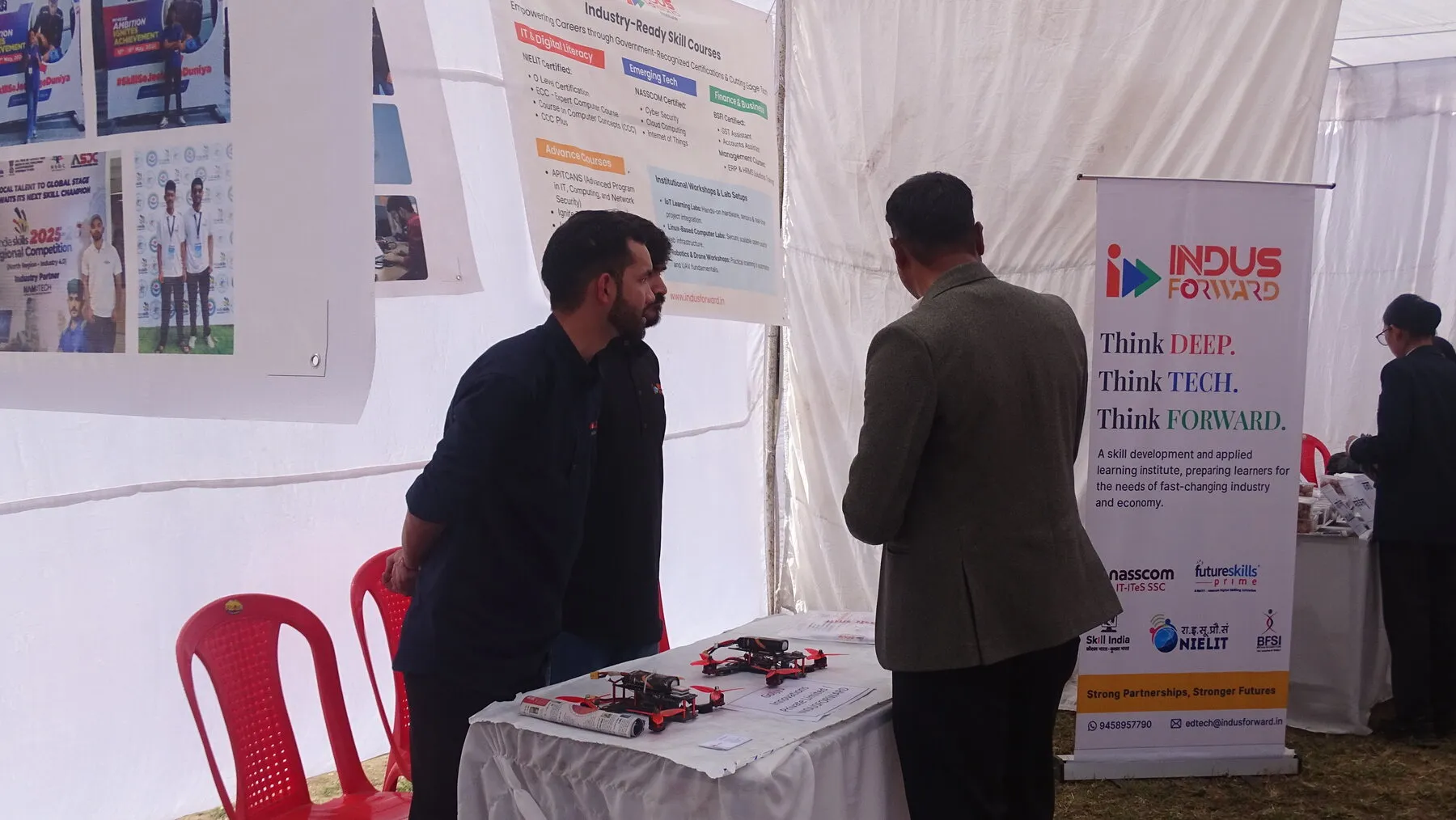
A school cyber club is not a side activity. It is an early sign of a region learning to protect digital value. A robotics lab is not only a room with kits. It is a place where students begin to connect physics, electronics, software and field problems. A drone workshop is not only a demonstration. It can open questions about terrain, mapping, agriculture, disaster response, inspection and public infrastructure. A cloud session is not only a dashboard tour. It can teach students how modern systems are deployed, scaled, secured and monitored.
This is why school collaborations are central to the movement.
Schools do not have to do everything alone. The movement can support them through seminars, lab setup, curriculum guidance, competitions, mentoring, clubs and public events. Colleges, alumni, companies, practitioners and local leaders can contribute too. The important thing is that students see a pathway, not only an event.
Lab setup services also belong in this economic argument. A cyber lab, computer lab, IoT lab, robotics lab or drone learning environment is useful only if it becomes a place of repeated practice. Hardware by itself does not create capability. But hardware joined with mentors, problems, projects, clubs and public standards can become productive infrastructure.
That is the practical meaning of building an economic engine from below.
R&D Close To Home
Research and development should not remain distant from hill districts.
This does not mean every town needs a large research campus. R&D begins when students learn to ask sharper questions, test ideas, build prototypes, document failures, compare methods, understand systems and improve their work. It begins when teachers and mentors create continuity. It begins when schools treat labs as places of experimentation rather than storage.
R&D close to home also changes the meaning of staying connected to the region.
For many young people, opportunity has often meant leaving. There is nothing wrong with leaving to study, work, learn and grow. The opportunity now is to create more credible paths near home as well, so that movement becomes a choice rather than a compulsion.
Deep technology can create a different possibility.
A student may still study in another city. An engineer may still work for a national or global company. A founder may still serve customers outside the state. But if the student remains connected to local schools, if the engineer mentors a club, if the founder hires from the region, if public examples show that high-value work can be rooted here, the relationship between talent and place changes.
The aim is not isolation.
The aim is connection with more local strength.
Uttarakhand should connect to national and global technology networks with confidence. It should produce students who can enter those networks with strength, learn from them, contribute to them and bring capability back into local ecosystems.
What An Economic Engine Looks Like In Practice
The early signs of an economic engine are not always dramatic.
They may look like a group of students meeting after school to solve CTF challenges. They may look like a teacher learning enough Linux to support a club. They may look like a robotics lab where a sensor project fails five times before working. They may look like a public exhibition where students explain their work. They may look like a college workshop that introduces systems thinking. They may look like a mentor call on a Sunday. They may look like a student documenting a mistake so that the next student does not repeat it.
These acts are small, but they are not trivial.
They create habits behind serious work.
Over time, the pattern should become visible:
- More students encounter serious technical fields early.
- More schools host clubs, labs, seminars and competitions.
- More mentors find specific ways to contribute.
- More students attempt CTFs, hackathons, projects and public demonstrations.
- More families understand that deep technical preparation can be meaningful.
- More local examples prove that capability can emerge from here.
- More students become employable in high-value fields.
- More students become founders, researchers, engineers, security professionals, teachers and mentors.
This is the flywheel.
Exposure creates curiosity. Practice creates capability. Proof changes belief. Belief brings more students and mentors. More students and mentors create a talent pool. A talent pool attracts opportunity. Opportunity strengthens the regional economy.
Not A Copy Of Another City
The question is not whether Uttarakhand can become a copy of Bengaluru, Hyderabad, Pune or Gurugram.
That would be the wrong imagination.
Uttarakhand has its own geography, memory, temperament and constraints. The better question is what kind of high-value capability can grow from here in a way that belongs to this place.
A hill state does not need to imitate the noise of a metropolitan ecosystem. It needs a patient technical culture. It needs students who can stay with difficult problems. It needs teachers who value foundations. It needs mentors who can repeat the basics without impatience. It needs public stories that make effort visible. It needs schools that see labs as living spaces. It needs families who understand that earned capability is more valuable than short-term excitement.
This is quieter than hype.
It is also more durable.
The Long Discipline
Prosperity is already supported by many sectors and contributors.
Innovation can transform the next layer.
It can add production.
It can add capability.
It needs economic engines that create value from here.
The aim is not to make every student a founder or every town a tech hub. The aim is to increase the number of young people who can participate in high-value production chains while existing sectors continue to contribute in their own important ways.
Some students may win medals. Some may enter top technical programs. Some may become security professionals. Some may work in cloud, AI, robotics, drones or engineering. Some may build companies. Some may become teachers. Some may mentor the next batch. Some may leave and remain connected. Some may return. Some may build quietly from where they are.
All of this matters.
If this work compounds for years, Uttarakhand can create more than individual success stories. It can create a regional capability base. That base can support better jobs, stronger schools, more confident families, more technical founders, better public-service capacity and a deeper place in the economy of the future.
This is why #InnovateInUttarakhand is not only a cultural or educational campaign.
It is an economic argument.
Uttarakhand already contributes through many forms of work.
Deep technology can become another way to produce value in the age ahead.